Showing posts with label Doctor Who. Show all posts

Thursday, January 7, 2010

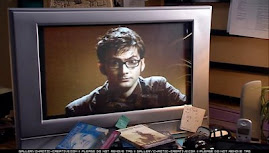
Goodbye David, Hello Matt


Steen Moffat on Matt Smith as the Eleventh Doctor (courtesy of the Radio Times):
"Because Matt is the youngest actor to play the Doctor, people might be thinking they’ll get a “young geezer” Doctor, but he isn’t that. He’s restored the more professorial aspect of the character – he’s very much the “nutty professor” Doctor.

What I least expected from Matt, given the nature of the modern Doctor, is that at times he’s very quiet, the strong, quiet man. I suppose I thought instinctively that he’d be a leaping-about, loud Doctor, as we’ve got used to. Yet some of Matt’s most powerful moments are when he’s very, very quiet... very, very gentle, in a way that a very powerful person can be. There’s a scene I watched just recently in which he was chillingly good: a big confrontation-with-the-alien scene, and instead of playing it – as he could have – in a much more bombastic way, he was very quiet, very matter-of-fact, very simple. It’s all implied strength rather than demonstrated bluster.

Matt carries off the gravitas thing perfectly and has no difficulty at all in lording it over other people. He has scenes with Winston Churchill – in which he behaves like Winston Churchill’s dad! And you have no difficulty in buying that on-screen. And then, of course, he’ll behave like a complete spoilt child, which is what the Doctor has to do – to suddenly become a huge big kid.

He is a terribly distinctive actor. And he has the most extraordinary face. He was born to play an alien, because it doesn’t quite add up. He’ll hate me for saying this, but he looks like a caricature of a handsome man; it’s all just a bit too much: perfect profile, perfect jaw-line, extraordinary. And the camera adores him. So you’ll be seeing a lot of that face, suffering, in close-up, I tell you!:


Monday, October 26, 2009

The Master is Back!

A wonderful interview with John Simms on the Jonathan Ross show on BBC Radio 2 (26th Sept 2009) about his return to Doctor Who for the END OF TIME 2010 Christmas Special:


Sunday, August 2, 2009

Doctor Who - The Waters of Mars Trailer

Its the beginning of the end for the Tenth Doctor ...


Tuesday, July 28, 2009

Sightings of the 11th Doctor


Courtesy of the Sun newspaper. Nice to see River Song again!


Saturday, July 11, 2009

Who is K'Anpo Rinpoche?

"The old man must die, and the new man will discover to his inexpressible joy that he has never existed." (Cho-Je, aka K'Anpo Rinpoche)

K'Anpo Rinpoche is a timelord from the planet Gallifrey, encountered by the Third Doctor in the episode PLANET OF THE SPIDERS. At first the Doctor does not recognise the Rinpoche, but soon realizes that he is an important figure from his own early years on Gallifrey. K'Anpo Rinpoche advises the Doctor that he must confront his greatest fear (death) in returning a mystic crystal to the "Great One" (a giant spider being) residing in the Blue Mountains of Metebelis Three. The Doctor does this, defeating the Spiders in their plan to become masters of the universe, but in the process he is "killed" and forced to undergo a regeneration into the fourth Doctor. Rinpoche himself regenerates in this episode into Cho-Je, another Buddhist monk, but remains a Buddhist practitioner and teacher in the Tibetan tradition.

K'Anpo was first referred to in the Doctor Who story THE TIME MONSTER, in an account that is a clear allusion to the classic Buddhist account of the founding of Zen Buddhism. In this story the Buddha silently - and with an enigmatic smile - proceeds to offer a teaching to his followers but instead of speaking merely offers them a lotus flower (a Buddhist symbol of enlightenment). Only Kashyapa fully understands the Buddha's import, thereby becoming the first Ch'an/Zen master and establishing a lineage of Ch'an/Zen teachers through a tradition know as the "direct transmission of the lamp". This refers to the wordless nature of the Buddha's teachings (the Dharma) and the necessity of passing such enlightened insight through a direct teaching method - lamp to lamp, from enlightened master to pupil in an unbroken lineage. K'Anpo, and his significance for the Doctor, is recounted in the following dialogue between the Third Doctor and his assistant Jo Grant (from the episode the Time Monster):

"JO: It makes it seem sort of pointless, really, doesn't it?

DOCTOR: I felt like that once when I was young. It was the blackest day of my life.

JO: Why?

DOCTOR: Ah, well, that's another story. I'll tell you about it one day. The point is, that day was not only my blackest, it was also my best.

JO: Hmm? Well, what do you mean?

DOCTOR: Well, when I was a little boy, I used to live in a house that was perched half way up the top of a mountain. And behind our house, there sat under a tree an old man -- a hermit -- a monk. He lived under this tree for half his lifetime, so they said, and he learnt the secret of life. So, when my black day came, I went and asked him to help me. JO: And he told you the secret? Well, what was it? DOCTOR: Well, I'm coming to that, Jo, in my own time. Ah, I'll never forget what it was like up there. All bleak and cold it was -- a few bare rocks with some weeds sprouting from them, and some pathetic little patches of sludgy snow. Yes, it was just gray -- gray, gray, gray. Well, the tree the old man sat under was ancient and twisted, and the old man himself was... he was as brittle and dry as a leaf in the autumn. JO: Well, what did he say? DOCTOR: Nothing, not a word. He just sat there silently, expressionless, and he listened whilst I poured out my troubles to him. I was too unhappy even for tears, I remember. And when I'd finished he lifted a skeletal hand and he pointed. Do you know what he pointed at? JO: No. DOCTOR: A flower -- one of those little weeds. Just like a daisy it was. Well, I looked at it for a moment, and suddenly I saw it through his eyes. It was simply glowing with life, like a perfectly cut jewel. And the colours -- well, the colours were deeper and richer than anything you could possibly imagine. Yes, that was the daisiest daisy I'd ever seen. JO: And that was the secret of life -- a daisy? Hmm. Honestly Doctor. DOCTOR: Oh yes, I laughed too when I first heard it. So later, I got up, and I ran down that mountain, and I found that the rocks weren't gray at all. Well, they were red, brown, purple and gold. And those pathetic little patches of sludgy snow -- they were shinning white -- shinning white in the sunlight. You still frightened, Jo? JO: No, not as much as I was. DOCTOR: That's good."


Video also available here: http://www.youtube.com/watch?v=bhmbxvT1gOA

TORCHWOOD: CHILDREN OF EARTH: Was this the darkest TV Sci-Fi story ever?

WARNING: * SPOILERS*

TORCHWOOD (anagram for 'Doctor Who') was once a small-scale 'adult-oriented' spin-off series in the DOCTOR WHO universe but in the UK it has just had its epic five-part third season broadcast on BBC1 on five successive evenings in one week. Russell T Davies, arch re-creator of all things WHOVIAN on BBC TV, is leaving both DOCTOR WHO and TORCHWOOD at the end of 2009 and has clearly decided to go out with all guns blazing. The TORCHWOOD plot explores the darker side of human nature and is in many ways a more darkly impressive version of THE SOUND OF DRUMS but with the added desperation of having no DOCTOR in sight to save the day with his sonic screwdriver. The post-watershed timeslot has allowed RTD to explore a number of powerfully dark themes - including a characteristically RTD take on the Machiavellian machinations of the state, a detailed exploration of the self-interested, behind the scenes decision-making of our politicians and civil servants, multiple references to a prevailing homophobia in contemporary Britain and, most dark of all, our willingness to sacrifice the children of others for the sake of our own safety and well-being. Surely, no other Sci-Fi TV show before has explored the idea that the British government could conspire to turn 10% of our children into recreational drugs for alien consumption. 

Throughout the story we see the ongoing use by RTD of biblical and Christian (or perhaps in the case of the contemporary Britain we should say 'post-Christian') themes, mostly played out through the eponymous character of CAPTAIN JACK, played with gusto as ever by John Barrowman. Jack is transformed from cheeky chappie, to gay lover, to bag of exploded body parts (Is Jack's member still throbbing somewhere in the ruins of the Torchwood compound in Cardiff city centre?), to large slab of concrete, to monstrous collaborator, to bereaved lover, to self-appointed world-saviour, and finally to broken hero, all in the space of five days of action. Jack, a kind of highly-sexed and poly-sexual CAPTAIN SCARLET, a time-traveller originating from the more sexually liberated 51st Century, is a character of biblical proportions - at one point in the plot his resurrectional qualities are compared to LAZARUS, at another - he is portrayed as a CHRIST-like, crucified and broken leader of men, resurrected to save the world (on the third day no less) and then finally cast as a father forced to play the role of ABRAHAM in sacrificing his own kin for the sake of saving the human race and avoiding the wrath of vengeful god-like beings.

Here is an excellent review (text pasted below) of this epic TORCHWOOD event from the TIMES (UK)  by Caitlin Moran:

Torchwood (BBC One) (Saturday July 11th 2009)

The thing that I’ve just realised about Torchwood — and God knows why it has taken me so long — is that it is essentially very, very silly.

Why did I never notice it was silly before? How could I not have noticed that? What did I think it was — normal? This is not normal. It’s the bloke from Tonight’s the Night saving the Earth from a souped-up basement in Cardiff. In a fractionally different universe — the type Torchwood deals with all the time — it could be Des O’Connor kicking alien butt from a “special” loft in Cornwall; or Il Divo thwacking Greys in Troon. Torchwood has a level of inbuilt ludicrousness so large that it may even be the bedrock of its existence.

But despite all the silliness, or maybe because of it— after all, it never did the equally ludicrous Spooks any harm — Torchwood has gone from strength to strength. For a show that started as a cultish Doctor Who spin-off, Torchwood now has an international audience — it, like David Hasselhoff, is huge in Germany, and it is BBC America’s biggest show — and has grown in prominence in the UK. From a late-night slot on BBC Three, the second series of Torchwood got bumped up to BBC Two, and last week Torchwood: Children of Earth was stripped across five nights on BBC One, essentially making July 6-11, 2009 the BBC’s “Torchwood Week”. Given its inexorable promotion through the BBC’s channels, you do wonder where the BBC will schedule the next series. At this breakneck rate, it will have to invent a special BBC Platinum First Class for it.

With five nights to play with, the scripts of Russell T. Davies and, on Wednesday, James Moran, took on an Aga slow-cook with the plot. It was your classic “aliens are coming to steal our children” scenario. Aliens make contact, demanding 10 per cent of the Earth’s children, or they will wipe out the human race. A high-ranking civil servant — Frobisher, played by the always hot Peter Capaldi — is put in charge of the crisis, which is in some way linked to a secret event in 1965. Back then, the aliens were referred to merely by a number, “The 456”. The 456 are, from their disturbing name up, clearly bad news. In all his increasing dealings with them, Capaldi does a good impression of a man gradually losing all the saliva in his body from pure terror.

Meanwhile, and obviously, Torchwood gets involved. Two major cast members died in the last series, but that’s OK, because Captain Jack is just about to pay an incredibly unexpected visit to his daughter and grandson! Yeah, that’s right. But Jack didn’t have much time to enjoy being the world’s first bisexual, immortal granddad. By the end of Torchwood Monday, a bomb sewn into his stomach had exploded, destroying the Torchwood Hub. Given that the big fact about Captain Jack Harkness is that he ends up, billions of years into the future, being the Face of Boe, the explosion raised the real possibility that this was the point at which he lost the “Rest of Boe”, and that the remainder of the series was going to revolve around John Barrowman’s head stuck in a jug.

But as Torchwood Tuesday confirmed, the power of light entertainment is so strong that in Barrowman it takes a lot more than 3kg of high explosive detonating in his intestinal tract to stop him. This is, after all, a man who can handle a Barry Manilow medley in a glitter suit, while dancing down some steps, and then do a live throw to a karaoke team of nurses from Arundel. Having been reduced to mince, although admittedly, not for the first time in his life, Barrowman managed to reassemble and then re-animate; just in time for a government hitwoman to entomb him, alive, in concrete. I know. In another world, it could have been Bruce Forsyth in there.

The next five minutes marked what will surely be the all-time highpoint of Torchwood silliness: the rest of the Torchwood team busting the concrete-covered Jack out of a secure military compound on a forklift truck. While I don’t have much hands-on experience with forklifts, I’m fairly sure their mph tops out at about 3mph, possibly 5mph, if you floor it. It seemed fairly obvious that if anywhere on the secure military compound the government assassins had been able to find even a golf cart, or a pogo stick, they could have successfully given pursuit of a forklift operated by a screaming, pregnant Welsh woman, bearing the fourth plinth from Trafalgar Square on its prongs.

But what was ultimately devastating about Torchwood Week was that, by Torchwood Wednesday, the encroaching darkness of the 456 started to crush brutally all the silly, Scooby Doo-ness out of the show. Indeed, by yesterday’s concluding episode, it was hard to imagine that Barrowman had ever starred in a two-month run of Aladdin at the Birmingham Hippodrome, in a pair of peach-coloured satin harem-pants.

The 456, you see, materialised in the M15 building, in a glass box full of poison, screaming and ejaculating against the misty windows. Even without the screaming, Murray Gold’s orchestral theme for the 456 — dissonant, corroding, two-note brass stab, as if this was all of Holst’s Mars that could be salvaged after a nuclear catastrophe — made every scene with the 456 feel hopeless: as if they’d already won. When we finally pierced the mist, and got to see what the 456 looked like, we found that each one had a human child, stolen in 1965, bound up and living in its ribcage, like a silk-bound fly in a web; eyes bulging and black.

The aliens didn’t need the children because they were dying; a scenario in which, in our sci-fi conversant age, one is apt to think, “Fair enough, aliens”. But the aliens wanted the children inside them “because they make us feel good. There are,” the 456 explained, delicately, “chemicals.” Human children were, in short, alien narcotics. And to prevent the world’s destruction, the Government was willing to turn dealer to the 456. In a plot-move that will surely see exam results rise perpendicularly among young Torchwood fans, the Government chose the sacrificial 10 per cent on the basis of schools Sats results — “the ones who are going to spend a lifetime on benefits anyway” — and sent in the Army to round them up.

Society began to collapse. Children were bussed to collection points as their mothers wept. Ianto, Captain Jack’s lover, died in the confusion. Capaldi, unable to save his own children, quietly went upstairs into his daughter’s pink bedroom and shot his entire family. Anyone who had been watching Torchwood Friday as the prelude to a “big night out” would have silently taken off their stilettos around 9.30pm and sat silently on the sofa with a large vodka, crying.

In the end, the only way to save all the Earth’s children was to “fry” Jack’s newly discovered grandson. The boy vibrated in the centre of a metal plate, blood pouring from his nose and ears, screaming, before he died. It was an ending so unhappy that Jack teleported off the Earth ten minutes later, in much the same way that Russell T. Davies has teleported off to Los Angeles: finished with Doctor Who, leaving Torchwood’s future up in the air, and exiting on such a cold moral appraisal of humanity’s attitude to its children that you wondered if Torchwood could ever be silly again. As the 456 pointed out, we let thousands of children suffer and die every day for no reason other than indolence. At least the 456 were getting a kick out of it.